SFDR 2.0: Disclosure or Labels Were Never the Point. Intent Finally Gets to What Is.

2008. Lehman Brothers has collapsed. And I’m managing an environmental technology fund.
Fully invested, small-cap bias baked in by a strict 70% revenue requirement, the portfolio isn’t about to be spared. In the panic of a recently appointed portfolio manager, I unearth a water utility in the midst of a takeover. A (partial) safe haven, it is entirely aligned with what that fund is trying to do. In other words, the intent of that position is clear to me.
But I can’t buy it. The governance and construction framework behind the portfolio will not allow it.
The intent is clear; the evidencing architecture is not.
From disclosure to something harder
SFDR 1.0 was fundamentally a transparency exercise. The original logic was that if fund managers disclosed how they thought about sustainability, the market would do the rest. Article 8 and Article 9 were disclosure categories, and the regulation never called them labels. The industry turned them into labels anyway, and then spent years arguing about what they meant. The Commission tried to fix this through clarification. As we all know now, this was largely unsuccessful. The categories had been absorbed into market before the ink was dry. Fund managers found themselves accused of greenwashing without a clear definition of their crime, prosecuted under a framework nobody had fully written and judged against standards that kept shifting. When a measure becomes a target, it ceases to be a good measure; Article 8 and Article 9 are perhaps the most expensive proof of the principle the fund industry has ever produced.
While looking for trees, the sustainable finance industry built itself a wood, one label at a time. SFDR 2.0 is the path out.
The shift we are seeing between SFDR’s first iteration and the proposal for its second is as simple to describe as it is difficult to implement. The new framework does not ask how you disclose your sustainability approach. It asks what your portfolio is actually trying to do, whether your portfolio construction reflects that, and whether you can demonstrate the connection between the two. The process matters as much as the output.
Why intent is harder than it sounds
Most portfolio managers assume intent is the easy part. They built the portfolio. They know what it does.
Pull up the top holdings of any ESG-labelled fund your company has a fiduciary duty on. If at any point you notice a holding where you feel a faint but persistent uncertainty about why exactly that company belongs in that particular portfolio, then you’ve identified a red flag around your intent.
That nagging feeling of "I am not quite sure how I would justify this one if pressed," is a signal. It means the portfolio's intent is not shared, documented, aligned or internalised in a way that would withstand scrutiny. It means that whoever put that holding in the portfolio understood the fund's purpose differently from whoever is looking at it now. Perhaps, even, differently from the client who bought into the portfolio, and quite possibly differently from the regulator who will eventually ask about it.
This situation is far from rare. In fact, I would argue it is universal.
That is now changing with SFDR 2.0. The industry has always been better at describing what sustainable investing is than at demonstrating what it does. The gap between these two concepts is long tenured and well worn.

What SFDR 2.0 actually requires
The bar has moved. What felt novel, even challenging five years ago is now the bare minimum. Under the new framework, sustainability is not something you describe, but something you embed. It must be present at the point of investment decision, traceable through the methodology, and auditable when challenged. The label the fund carries is a claim that requires evidence, not a story that requires telling.
This changes how we must think about portfolio construction from the offset. The exclusions are stricter. The thresholds are precise. The connection between what a fund claims and what it holds is no longer a matter of narrative judgment, but a question of architecture.
The practical implication is that investment organisations must now tackle the work they have mostly avoided, defining, in terms that are consistent across every team that touches the portfolio, what a given fund is actually trying to achieve, why certain companies qualify and why others do not, what the boundaries of the mandate are, and how they connect to the real world outcomes the fund is supposed to serve.
This structure should already exist. In most organisations running ESG branded assets, it does not. At least not in a form that is precise enough, consistent enough or documented well enough to meet the demands now being placed on it.
The direction of travel is clear
Industries like pharmaceuticals and cosmetics have long operated under a principle that the financial industry is only now being introduced to: you cannot make a claim before you can evidence it. You don’t describe the benefits of a product and then decide later how you’ll demonstrate them. The evidence architecture must come first.
SFDR 2.0 is not yet at that level of rigour, but the direction is unmistakable. For too long, sustainability intent has been whatever the marketing materials needed it to be. The regulation is now asking for the same answer from the portfolio manager, the compliance team and the sales desk. At the same time. In writing.
My water utility back in 2008 didn’t fail a sustainability test. It failed a documentation test. Nearly 20 years later, SFDR 2.0 is providing a path to plug that gap.
The labels and the disclosure were never the hard part. The intent behind the portfolio has always been the stumbling block - which is probably why the industry spent twenty years building frameworks around everything except that. SFDR 2.0 is the canary in the coal mine, warning us that the rest of the world has run out of patience with the detour. Frankly, I can’t blame them.
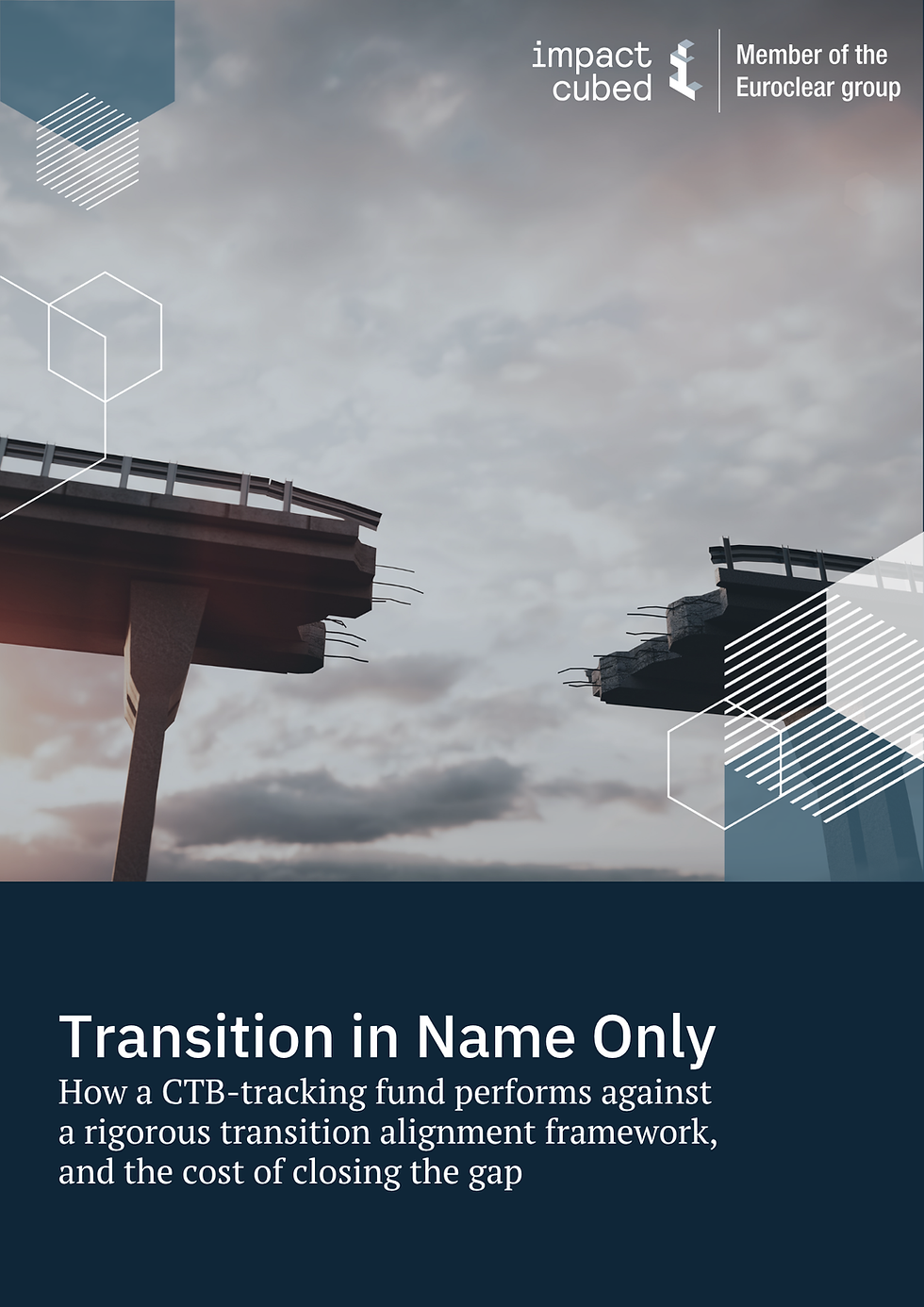
Transition in Name Only
To learn about Impact Cubed's quantitative Transition Dataset, its applications for investors, and what we found when we applied it to a CTB-tracking fund, click below.


Comments